
Technical for Non-Technical
EV & Hybrid Technology explained with a little help from our EVHBCA team

Buying a used electric or hybrid vehicle can involve technical information that isn't always easy to understand.
At EVHPPI, we believe you shouldn't need to be an automotive technician to understand the condition of a vehicle you're considering purchasing.
Here are five important things worth understanding before buying a used EV or hybrid.

What is Battery State of Health (SoH%)?
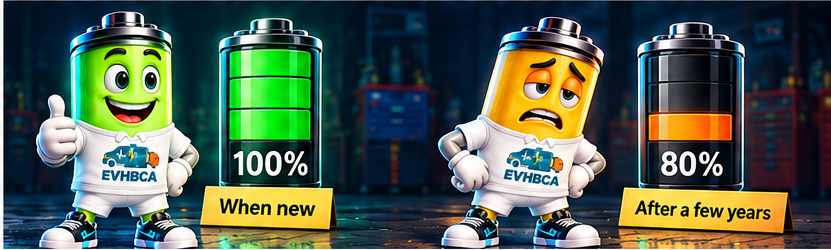
Battery State of Health (SoH%) tells you how much usable energy capacity your EV or hybrid battery has left compared with when it was brand new.
100% SoH means the battery retains approximately 100% of its original reference capacity.
80% SoH means the battery has lost approximately 20% of its original capacity through ageing and use.
Even when your dashboard shows 100% charged, the battery may only store 80% of the energy it could when new. This can result in a shorter electric driving range.
Think of your smartphone.
When you first buy a new phone, a full charge might last all day.
After a few years, the phone still displays 100% charged, but you notice the battery runs out much sooner.
That's because the battery has gradually lost some of its original capacity.
The same thing happens with EV and hybrid batteries.
Understanding battery State of Health helps you assess battery condition and potential electric driving range before purchasing a used vehicle.

What is Battery Cell Balance & Delta Voltage?
Your EV or hybrid battery is made up of many smaller battery cells working together to store and deliver electrical energy.
Ideally, these cells should maintain similar voltage levels under comparable conditions.
Delta Voltage (ΔV) measures the difference between the highest and lowest cell or monitored cell-group voltages.
A smaller Delta Voltage generally means the battery cells are more closely balanced, while a larger difference may indicate an imbalance requiring further investigation.
Think of a game of tug-of-war.
Imagine a team of people pulling together in a tug-of-war competition.
When everyone pulls with similar strength, the team works together effectively.
But if one person is significantly weaker than the others, they can affect the performance of the entire team.
Your EV or hybrid battery works in a similar way.
The battery contains many individual cells working together. If one cell or cell group behaves differently from the others, it can potentially affect the performance of the entire battery pack.
A voltage difference alone doesn't prove a cell is weak or defective. Battery type, State of Charge, temperature and operating conditions must also be considered.
A higher Delta Voltage does not automatically mean a battery cell is defective.
That's why EVHPPI assesses battery cell voltage readings alongside other available battery diagnostic information to help determine the overall battery condition.

Why Do Battery Temperatures Matter?
EV and hybrid batteries generate heat when charging and delivering electrical power.
Battery temperature management systems help maintain suitable operating temperatures to protect battery performance and lifespan.
If one area of the battery is consistently much hotter or colder than others, it may indicate uneven operating conditions, a cooling system concern or another issue requiring investigation.
Think of exercising on a hot day.
When you're exercising, your body generates heat. To prevent overheating, you start sweating to help cool yourself down.
But if you become too hot, you may need to slow down or stop to avoid becoming unwell.
Your EV or hybrid battery works in a similar way.
Just like your body regulates its temperature, an EV or hybrid uses a battery temperature management system to help keep its battery operating within suitable conditions.
If battery temperatures become excessive, the vehicle may limit charging or power output to protect the battery.
Over time, excessive heat can also accelerate battery degradation.
Understanding battery temperature readings helps identify potential concerns that may not be obvious during a normal test drive.
What Are Diagnostic Fault Codes (DTCs)?
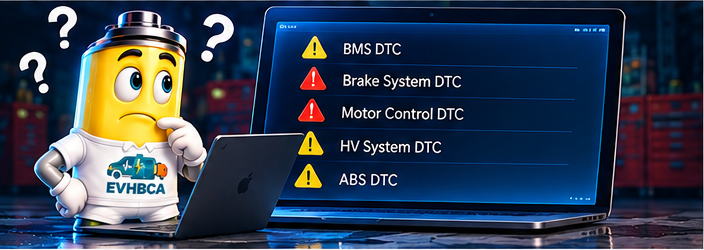
Modern EV and hybrid vehicles contain numerous electronic control systems that monitor the battery, electric motors, braking, steering, safety systems and much more.
When one of these systems detects an unusual condition, it may record a Diagnostic Trouble Code (DTC).
Importantly, a vehicle can have stored fault codes even when no warning lights are displayed on the dashboard.
Think of your laptop.
Sometimes when you're using your laptop, a program stops responding and the little loading circle just keeps spinning.
It tells you something isn't working as expected, but it doesn't necessarily mean your laptop is broken. Sometimes closing and reopening the program fixes the issue, while other times further investigation is needed.
Your vehicle's diagnostic system works in a similar way.
A Diagnostic Trouble Code (DTC) tells us that a system has detected an unusual condition, but it doesn't automatically mean a component has failed.
That's why EVHPPI performs diagnostic scans before and after road testing, where safe and applicable.
This helps identify whether previously recorded faults return or new faults are detected during the inspection.

What Do GOOD, FAIR, POOR & N/A Mean?
Your EVHPPI inspection report uses condition ratings to help you understand the results of the vehicle's assessed components and systems.
GOOD — No significant concerns identified during the assessment.
FAIR — An issue or observation has been identified that should be considered.
POOR — A more significant concern has been identified that may require further investigation or attention.
N/A — The item was not applicable, was not assessed or was not included in the selected service, as explained in the report.
Think of a school report card.
When you receive a school report, not every subject necessarily receives the same grade.
A lower grade in one subject doesn't automatically mean the entire report is bad.
Your vehicle inspection report works in a similar way.
One FAIR or POOR rating doesn't automatically mean you shouldn't buy the vehicle.
What matters is understanding the actual finding, how serious it is and whether any repairs or further investigations may be required.
This information can help you make an informed decision and consider potential repair costs before purchasing.
Understanding Your Vehicle Before You Buy
At EVHPPI, our goal is to take complex EV and hybrid technology and explain it in a way that everyday vehicle buyers can understand.
Our inspections and diagnostic reports provide information about the vehicle's condition, helping you identify potential concerns before committing to a purchase.
Helping you make an informed purchase decision with confidence.
Book an inspectionWhich battery readings are available depends on the vehicle's make, model and year.